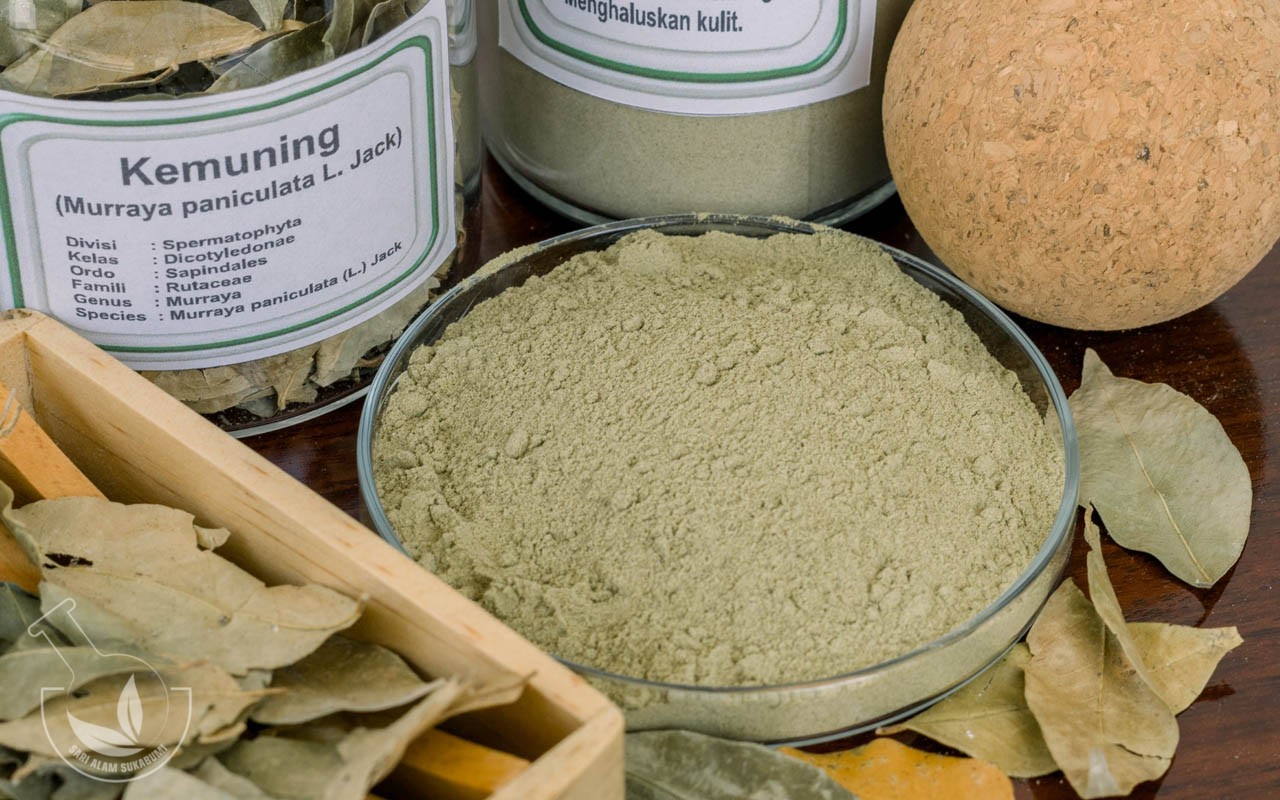
Kemuning or, as people often refer to it, “bunga kemuning” is a plant that grows wild in thickets and along forest edges, or is intentionally cultivated as an ornamental plant in gardens or as a hedge in yards. Kemuning (Murraya paniculata) is a plant in the Rutaceae family, also known as the citrus family. This plant, whose synonyms include Murraya exotica L., Murraya banati Elm, and Chalas paniculata, is a tropical species that can reach a height of 7 meters and blooms year-round. Its leaves resemble citrus leaves but are smaller in size.
 Image Courtesy : deherba.com
Kemuning can be found up to an elevation of approximately ± 400 m above sea level. There is a wide range of morphological variation. The varieties commonly planted as hedges around yards are typically those with small, dense foliage. A shrub or small tree, highly branched, 3–8 m tall, with a hard, grooved, thornless stem. The leaves are compound, odd-pinnate with 3–9 leaflets, arranged alternately. The leaflets are petiolate, obovate or oblong in shape, with pointed tips and bases, smooth or slightly serrated margins, 2–7 cm long, 1–3 cm wide, with smooth, glossy surfaces; they are green in color and odorless when crushed. The compound flowers are arranged in clusters of 1–8; they are white, fragrant, and emerge from the leaf axils or the tips of twigs.
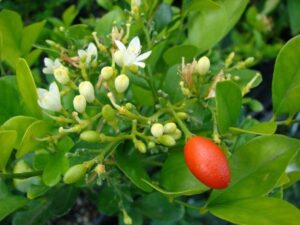 Image Courtesy : decyra.com